

We’ve reviewed multiple different footwear options from Teva now, including two in the last few months, so the question is probably fair: Why are we reviewing Teva on a running website?
Honestly, it makes sense in some ways and less so in others.
Teva is one of the bigger names in outdoor footwear, and a lot of us runners also happen to enjoy being outside. That makes Teva a pretty natural fit for Run Oregon. At the same time, Teva has historically lived more in the outdoor-lifestyle space — footwear designed for getting outside rather than necessarily something a runner would seek out for a training run.

That seems to be changing. With the launch of the Aventrail Road-2-Trail, Teva took its first real step toward the running world. I wouldn’t necessarily call that shoe a running shoe, but rather a “running-possible” shoe. It was something you could run in when the situation called for it.
The new Trailpeak feels different. This is Teva putting some actual thought into what a Teva trail-running shoe could be.
Looks:
I’m going to guess the look of the Trailpeak could be relatively polarizing. Somehow, it looks both like a running shoe and not like a running shoe at the same time.

I know that’s an odd thing to say, but the Trailpeak is inherently Teva. There are some design elements and color choices that you don’t typically see on trail shoes from the traditional running brands. The colors aren’t particularly flamboyant, but they’re different enough to stand out.
It’s not bad looking by any means. It’s just very… Teva.
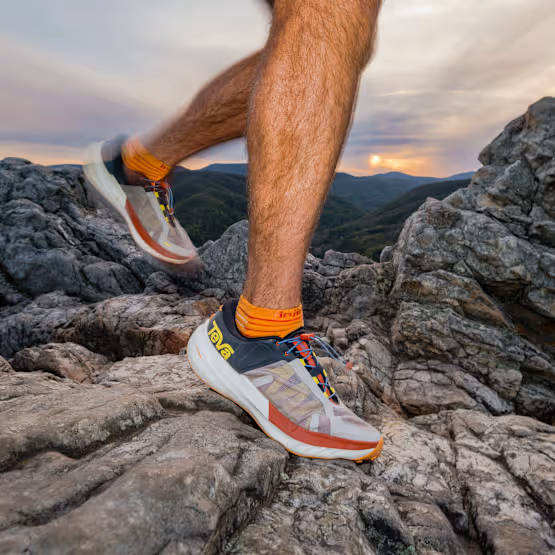
Currently, there’s a single colorway for both the men’s and women’s versions. They look relatively similar, although the women’s version features a light blue as its primary color while the men’s sticks with black. Personally, I’m more of a fan of the women’s colorway, but both work.+
Construction
Let’s get something out of the way right now: I’m not sure I would forgo my entire trail-running shoe lineup in favor of the Trailpeak. That sounds like a knock right out of the gate, but I assure you it isn’t.

Generally speaking, we don’t recommend replacing all of your standard footwear options with a brand-new shoe from a new company. But Teva isn’t a new company per se, with years of experience doing footwear. But still, it’s always good to tread lightly (pun intended).
To me, the Trailpeak feels much more like a daily trainer for the trails than a speed-focused trail shoe or a max-cushion endurance option. There’s enough responsiveness and structure here that I’d be comfortable pushing the pace a bit when the trail calls for it, but it doesn’t feel like Teva is trying to build a trail-racing weapon.

Instead, it’s a versatile, everyday option for runners who spend time on accessible trails and want something that can potentially double as handling both running and walking. It’s definitely lightweight and kind of interesting that there is no footbed insole because it is stitched right into the midsole layer – as close to foot on foam as you can get.
Specs
- Stack: 30.5mm / 24.5mm
- Drop: 6mm
- Lugs: 3mm
- Weight: 8.3 oz (Men’s 9)
Upper:
The first question we tend to get with Teva shoes involves the patented Velcro system. We’ve seen it on some of Teva’s other footwear, and while we’ve found that it holds up reasonably well, Velcro on a running shoe is always going to be a tough sell.

Teva has gone in a completely different direction with the Trailpeak. Instead of standard lacing — or its familiar Velcro — the Trailpeak uses a speed-lace system. I honestly couldn’t tell you going in whether I was going to like this or not. In practice, though, it works pretty well. The bungee-like cord allows for quick adjustments on the fly simply by pulling on the cord. It’s easy, it’s fast and it keeps with Teva’s history of doing things a little differently.
As I’ve said in plenty of reviews involving quick-lacing systems, most of them are perfectly fine. This one is too. But I still prefer a good standard lace as I never feel like I get the optimum hold in these types of shoes – the Trailpeak included.

Beyond the lacing system, the upper is quite good. There’s a healthy amount of padding around the heel, while the tongue is gutted and relatively thin but still provides enough padding across the top of the foot. That becomes particularly important with the speed-lace system because there’s enough material between your foot and the lacing to keep things comfortable.

There’s also some good lateral stability and foot hold (though probably not for bombing descents), which is helped by the visual cage that wraps around much of the upper. I don’t know if this was intentional, but the cage actually reminded me of Teva’s old Z-shaped Velcro hold.

Instead of having that strap wrap across the top of the foot, Teva has essentially incorporated a similar visual concept into the structure of the shoe. Maybe I’m drawing too much of a correlation there, but once I saw it, I couldn’t unsee it.
Midsole:
Any new trail shoe needs to get the midsole right, and Teva’s answer here is its supercritical HYPER-COMF+ foam. The TPU-based construction is designed to provide Teva’s lightest and most responsive underfoot experience, and I think it delivers.

The Trailpeak feels surprisingly solid underfoot — especially considering this is Teva. With a maximum stack height of 30.5mm in the heel and 24.5mm in the forefoot, there’s also a fair amount of ground feel which will work great for some runners and less so for others.
Without some sort of protection (like a carbon or rock plate) you can really feel the ground. Again, maybe a good thing to some, but for me it seems like it would lack some protection during more technical assaults. I definitely felt some sharper rocks, even on my moderate trail runs, which wasn’t ideal.

Even though the HYPER-COMF+ foam has some softness and responsiveness to it, this isn’t the most cushioned trail ride out there. I wouldn’t call it overly firm, but there’s definitely a more down-to-earth feel to the shoe. The Trailpeak feels much more like a daily trainer for moderate trail miles than a shoe designed to carry you through an ultramarathon or technical conditions.
Just know what you’re getting into before you lace them up. More on that in the conclusion below…
Outsole:
The outsole is made almost entirely from Teva’s Spider Rubber compound, paired with 3mm lugs. Testing these primarily during the summer, the grip felt perfectly adequate on the dry trails I typically run.

I’ll put the disclaimer out there for probably the millionth time: I don’t generally spend a ton of time running highly technical trails. Most of my trail running is on accessible, light- to medium-difficulty trails. Within that environment, the Trailpeak had no issues.
The 3mm lugs provided enough bite for climbing and descending (for me at least) without feeling excessive on more moderate surfaces. I do think technial trail runners may want a little bit more here, but you be the judge.
I wasn’t able to really test the limits of the outsole in super technical terrain or particularly wet conditions, so I can’t speak to how well the Spider Rubber compound performs when things get truly messy. That’s something that will take more time and more varied conditions to determine.

There is also a gaiter attachment on the heel, which gives you the option of adding a gaiter when conditions get more complicated.


